
What Makes Ceramics Useful?
Ceramics are generally made from inorganic materials and can be engineered to have different properties depending on their composition and processing. One of their most useful characteristics is their ability to remain stable at high temperatures. Many ceramics are also resistant to wear and corrosion, while some can act as excellent electrical insulators. These properties determine where engineers choose to use them.
However, ceramics are not simply “better” than metals or plastics. They have advantages and disadvantages. Many conventional ceramics are hard but brittle, so engineers have to choose the right ceramic for the right application.
Ceramics We See Every Day
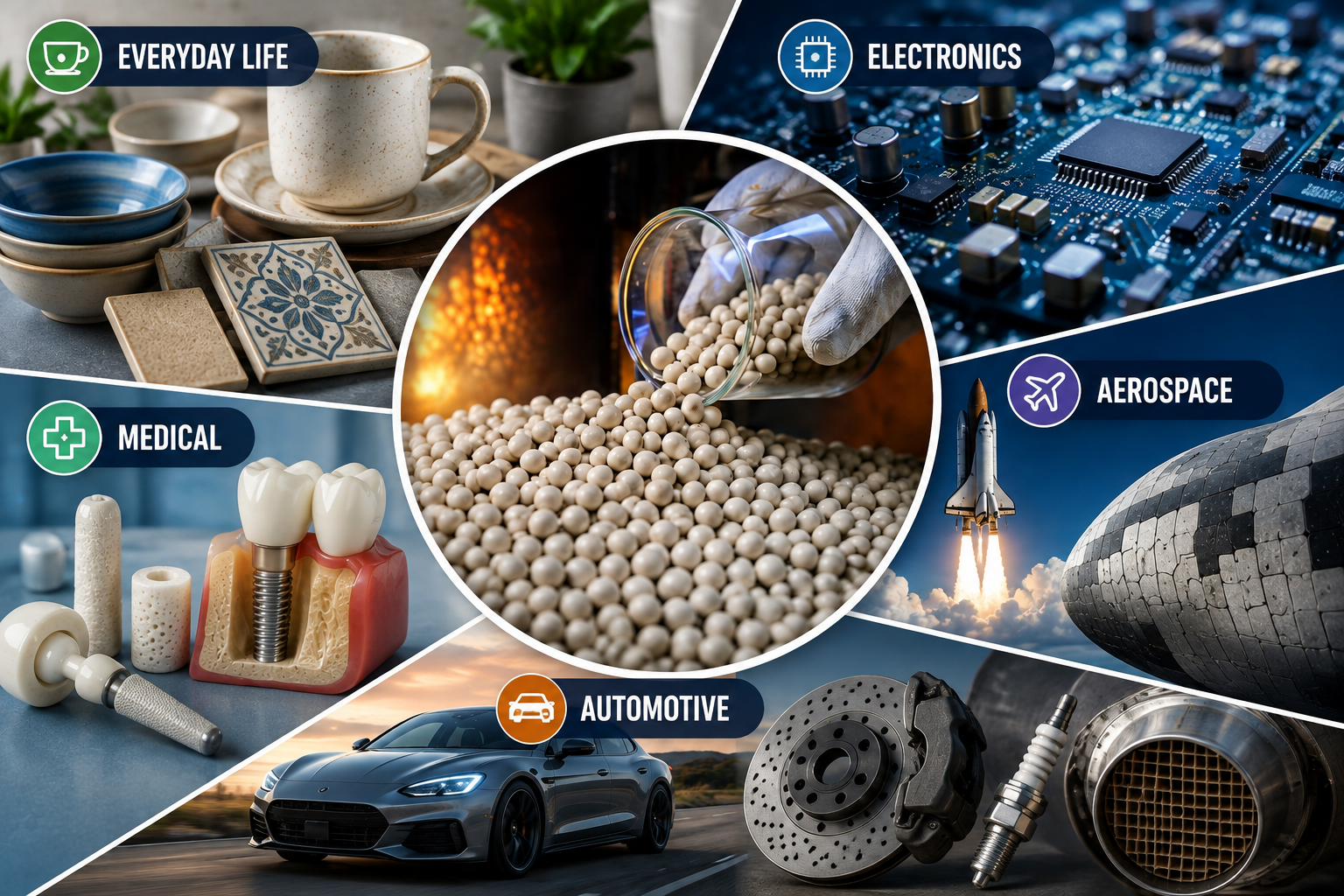
Some of the most familiar ceramic products are found inside homes. Ceramic tiles are used on floors, walls and countertops, while roof tiles can help provide water resistance and insulation. Ceramic materials are also common in kitchenware, bathroom fixtures and appliance coatings.
These everyday uses come from relatively simple material advantages. Ceramics can provide hardness, resistance to scratches and chemicals, and stability under heat. So, the ceramic cup sitting in a kitchen is connected to the same broader field of materials science that develops ceramics for much more demanding environments.
The Ceramic Parts Inside Electronics
Some of the most important ceramic applications are hidden from view. Ceramic materials are used in electronic components found in smartphones, computers, televisions, vehicles and medical devices. They can serve as electrical insulators and can also be engineered to have properties such as semiconducting, magnetic and piezoelectric behaviour.
One example is the multilayer ceramic capacitor, or MLCC. These components store electrical charge and are found in huge numbers across modern electronic devices. Some commercial MLCCs measure only 0.25 mm × 0.125 mm × 0.125 mm. Their tiny size allows manufacturers to fit many components into increasingly compact electronic systems.
Ceramics Can Turn Pressure into Electricity
Another interesting example is piezoelectric ceramics. These materials can generate an electrical charge when mechanical pressure is applied. They can also change shape when an electric field is applied. This property allows them to work in devices such as sensors, actuators, filters and other electronic components. Piezoelectric ceramics are also being used in areas including robotics, automotive systems and instrumentation.
This is a good example of how changing the composition and structure of a ceramic can give it a function that goes far beyond being simply hard or heat resistant.
From Cars to High-Performance Racing
Ceramics are also used in transportation. Cars and trucks contain ceramic components in mechanical and electronic systems because some ceramic materials are strong, durable and resistant to wear. Ceramic-based materials are also used in high-performance applications such as racing brakes. This is particularly useful where components experience friction, high temperatures or repeated mechanical stress.
Why Aerospace Needs Ceramics
Aerospace is one of the areas where ceramic materials become especially important. Aircraft and spacecraft operate in environments where weight, temperature, corrosion and durability can all become major engineering problems.
Ceramics can be useful because they are relatively lightweight, resistant to high temperatures and can provide electrical insulation. They are used in areas including engine and exhaust systems, thermal protection, brakes, bearings and other specialised components.
Some ceramic and ceramic-matrix-composite components used for high-temperature applications can withstand temperatures of up to about 1,600°C. Researchers are also developing ultra-high-temperature ceramics for environments reaching around 2,200°C, including potential use in hypersonic vehicles.
Protecting Spacecraft from Extreme Heat
One of the clearest examples of ceramic materials in space is thermal protection. A spacecraft returning through Earth's atmosphere experiences extreme heating. Ceramic materials can be used as thermal protection because they can tolerate high temperatures and help reduce the amount of heat reaching the spacecraft's structure.
The Space Shuttle, for example, used porous ceramic tiles as part of its thermal protection system during atmospheric re-entry. The important point is that the ceramic is not simply “heatproof.” Its composition, structure and ability to withstand the conditions of re-entry are what make it useful as a protective material.
Ceramics Have Limits Too
Despite their advantages, ceramics are not suitable for everything. Their hardness can make them resistant to wear, but many conventional ceramics are also brittle. Instead of bending significantly when subjected to a large force, they can crack or fracture.
Materials scientists therefore work on improving ceramic performance through changes in composition, microstructure and manufacturing. Ceramic-matrix composites, for example, combine ceramic materials with reinforcing structures to improve properties such as mechanical strength and resistance to thermal shock.
This is where materials science becomes important. Engineers are not simply choosing an existing material. They can change how the material is made to achieve a particular combination of properties.
From Pottery to Advanced Materials
Ceramics have existed for thousands of years, but modern materials science has expanded what they can do. The same broad category of materials that includes pottery and household tiles now also includes specialised components for electronics, vehicles, aircraft and spacecraft.
The difference is often in the composition, processing and microstructure. By controlling these factors, scientists and engineers can produce ceramics with properties designed for specific jobs. That is why ceramics remain important even as technology becomes more advanced. They are not just materials from the past. They continue to be engineered for some of the most demanding applications in modern technology.
What Comes Next
The development of advanced ceramics is likely to continue as engineers look for materials that are lighter, stronger, more heat resistant and more efficient. Future applications could involve improved ceramic composites, electronic components, high-temperature systems and aerospace technologies.
For materials scientists, the challenge is not simply making ceramics harder. It is finding the right combination of properties for each application while overcoming weaknesses such as brittleness and manufacturing complexity.
Career Takeaway
Ceramic materials research creates opportunities in materials science, chemical engineering, mechanical engineering, electronics, aerospace engineering and advanced manufacturing.
Professionals in these fields study how a material's composition, structure and processing affect its performance in real-world applications.
Useful Statistics
- The global electronics industry is estimated by the American Ceramic Society at nearly $4.5 trillion, with ceramic-based components playing important roles in electronic products.
- Some commercial multilayer ceramic capacitors are this small, demonstrating how ceramics contribute to miniaturised electronics.
- Ultra-high-temperature ceramics capable of withstanding temperatures up to about 2,200°C are being developed for applications including hypersonic vehicles.