
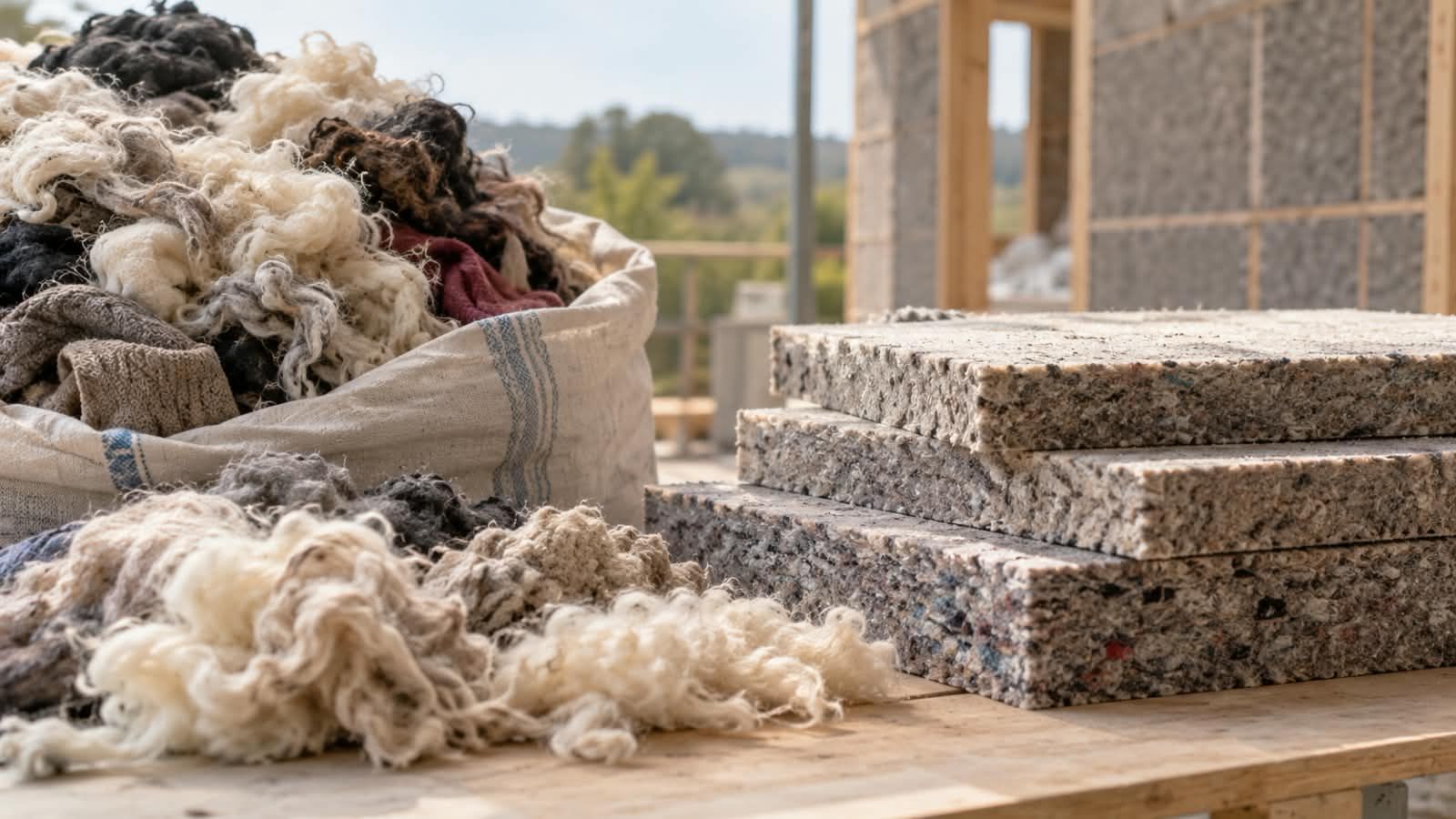
Why Waste Wool Is Worth Using
The scale of the waste problem is one reason researchers are looking at wool differently. Around 2 billion kilograms of wool are produced globally each year, and nearly half is estimated to remain unused. Some of this material can have limited value because it does not meet the quality requirements of the textile industry. Instead of treating it simply as waste, researchers are looking at whether its natural properties can be put to another use.
Wool is particularly interesting because its fibres can provide thermal and acoustic insulation. Previous research has investigated wool in insulation, panels, cement-based composites and other building components.
Turning Wool into a Panel
The recent research takes the idea further by creating a more rigid material. Researchers extracted keratin from waste wool and combined it with wool fibres. Citric acid was used to crosslink the keratin, while heat pressing helped form the mixture into a stiff panel.
The result was not simply a sheet of compressed wool. It was a bio composite, meaning the wool fibres and keratin-based matrix work together to form a new material with different mechanical properties from loose wool.
Can It Insulate a Building?
One of the most interesting properties of the new panels is their thermal performance. The researchers reported thermal conductivity as low as 0.067 W/m·K for their best-performing formulation. Lower thermal conductivity generally means a material is better at resisting heat transfer, which is important when designing building insulation.
The study also reported flexural moduli of up to approximately 1,906 MPa, showing that the material can be substantially stiffer than loose wool fibres. These results helped the researchers investigate the material for an exterior building retrofit and cladding system, rather than limiting it to loose-fill insulation.
The Environmental Advantage
The idea is not only about finding another use for wool. It is also about reducing the environmental impact associated with producing new construction materials. The 2026 study found that the waste-wool bio composite could have substantially lower embodied carbon than some conventional material benchmarks. In its life-cycle assessment, the reported global-warming potential was as low as 0.42 kg CO₂-equivalent per kilogram, and the value became negative when biogenic carbon storage was included in the calculation.
However, this does not mean every wool-based panel automatically has a negative carbon footprint. The researchers found that the source of the wool matters, and using waste wool can offer a much stronger environmental case than using wool specifically produced for the construction material.
From Textile Waste to Circular Construction
Waste wool is not the only textile material being investigated for construction. Recent research has examined recycled textile fibres for thermal insulation, acoustic applications and lightweight building components. A 2026 review of 131 studies found growing interest in turning textile waste into circular construction materials, while also pointing out that long-term durability, fire safety and indoor-environmental performance still need more research.
That is an important distinction. A promising laboratory material is not automatically a ready-to-use building product. Researchers still need to understand how these materials perform over years of exposure to moisture, temperature changes, fire and mechanical loads.
What Comes Next
Waste-wool panels are still at the research stage, but the concept shows how a material normally associated with the textile industry could find a second life in construction.
If researchers can improve manufacturing, durability, fire performance and cost while maintaining the environmental benefits, waste wool could become part of a wider move towards circular building materials — materials designed to make better use of resources that would otherwise be discarded. The bigger idea is simple: sometimes the next useful construction material may already exist in our waste streams.
Career Takeaway
Developing waste-wool building materials brings together materials science, chemical engineering, polymer science, construction engineering, life-cycle assessment and sustainable design. It shows how materials engineers can turn an environmental problem into an opportunity to develop new products.
Useful Statistics
- Approximately this amount of wool is produced globally each year, with nearly half estimated to remain unused.
- The best-performing waste-wool bio composite in the 2026 study reached this reported thermal conductivity.
- The highest reported flexural modulus of the waste-wool bio composite was approximately 1,906 MPa.
- A 2026 review analysed 131 studies on waste textile fibres and their potential uses in circular building materials.