
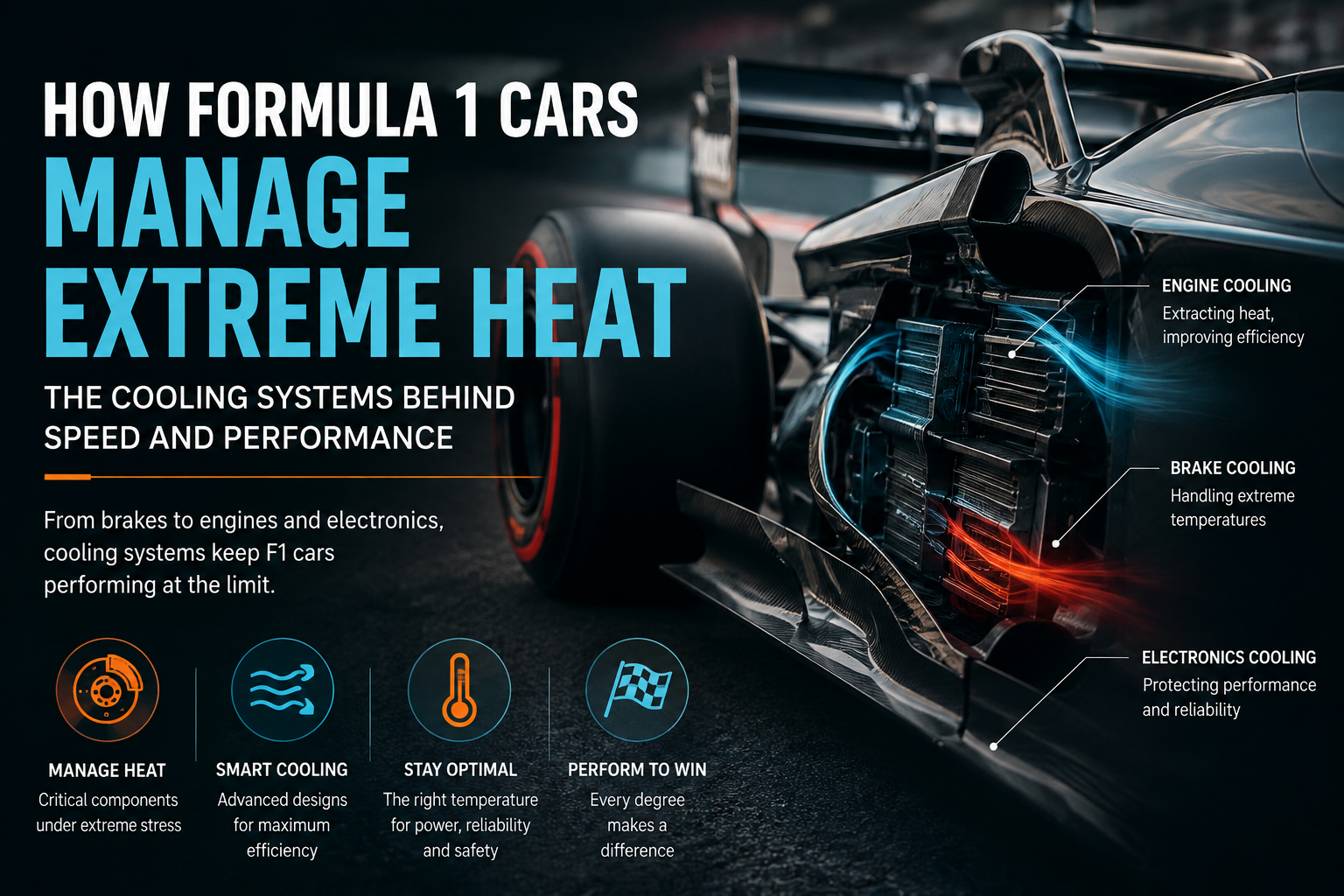
Why F1 Cooling Systems are an Engineering Trade-Off
Cooling a Formula 1 car is not simply a matter of removing as much heat as possible. Engineers have to control temperatures while protecting aerodynamic performance. Air enters the car through carefully shaped openings and is directed toward radiators, heat exchangers and other components that need cooling. The same airflow can also influence the aerodynamic behaviour of the car. Opening the bodywork further can increase the amount of cooling air available, but it can also affect drag and airflow around the car.
This creates a basic engineering trade-off. A cooling system must provide enough airflow to keep components within their operating ranges without creating unnecessary aerodynamic losses. The complexity of the problem is visible in the 2026 FIA technical regulations, which separately specify requirements for the energy store, electrical systems, oil and coolant systems, charge-air cooling and heat exchangers.
Three Major Heat Loads
An F1 car has several systems that generate or manage significant amounts of heat. The power unit produces heat during combustion and operation. Its cooling system includes oil and coolant systems and charge-air cooling. The FIA's 2026 power-unit regulations specifically include requirements for these cooling systems.
The energy store and electronics are another part of the thermal-management problem. The energy store is the rechargeable electrical storage unit in the hybrid power unit, while the energy-recovery system also includes control electronics.
The brakes create another major thermal challenge. During heavy braking, kinetic energy is converted into heat. Cadillac's Formula 1 team reports that F1 brake discs regularly reach more than 1,300°F (about 704°C). Brake ducts therefore direct cooling air toward the braking components.
Why Brake Temperature Matters
Brake cooling is especially important because an F1 car repeatedly converts large amounts of kinetic energy into heat during braking. Cadillac's explanation of its F1 brake-duct design describes how the braking system can experience deceleration forces of more than four times gravity while the discs reach temperatures above 1,300°F. The brake ducts therefore have to provide cooling while also fitting within strict aerodynamic and regulatory constraints.
The FIA's technical regulations also specify requirements for F1 brake discs, including dimensions and minimum cooling-hole diameter. This means engineers cannot simply make every cooling component larger. They have to find a design that manages temperature while remaining within the rules and preserving the aerodynamic characteristics of the car.
Why Mexico City Changes the Cooling Problem
The Mexico City Grand Prix provides a useful example of how the circuit environment can change thermal-management requirements. The Autodromo Hermanos Rodríguez is more than 2,000 meters above sea level. Formula 1 has explained that the air in Mexico City is approximately 25% less dense than at a sea-level circuit. The lower density affects both aerodynamics and cooling. Less-dense air provides less cooling capacity for components that depend on airflow.
In its 2019 technical analysis of the Mexican Grand Prix, Formula 1 explained that the thin air at Mexico City reduces cooling effectiveness. The effect is not limited to the brakes. Formula 1 has reported that teams also have to manage cooling for the engine and other systems at the circuit. That creates another trade-off. Teams may need larger cooling openings or different cooling configurations, but changes to the bodywork can affect aerodynamic performance.
Cooling Versus Aerodynamic Performance
The relationship between cooling and aerodynamics is one of the most important parts of F1 thermal engineering. A larger cooling opening can allow more air to reach a radiator or brake component. However, the additional opening can change the airflow around the car and increase the aerodynamic cost of cooling.
Formula 1 has documented this problem at Mexico City, where teams have had to open up parts of the bodywork to deal with the reduced cooling effect of the thin air. Brake cooling creates the same type of compromise. Formula 1's technical coverage of McLaren's 2024 Mexico City brake design explained that controlling brake temperatures was a major factor in race performance and that cooling choices had to be balanced against aerodynamic effects. The objective is therefore not maximum cooling. It is the right amount of cooling for the circuit and the conditions.
Why Thermal Management Changes from Circuit to Circuit
Every circuit presents a different combination of speed, braking demand, altitude, ambient conditions and aerodynamic requirements. At a high-altitude circuit such as Mexico City, lower air density changes both cooling and aerodynamic behaviour. At other circuits, teams may face different combinations of ambient temperature, track layout and braking demands.
This means a cooling configuration that works well at one circuit may not be ideal at another. Engineers can adjust cooling openings and other systems to respond to the expected demands of the weekend.
The 2026 FIA sporting regulations also recognise that cooling requirements can change with climatic conditions. They allow certain adjustments to power-unit and gearbox cooling bodywork and cooling-system settings under specified conditions.
The Engineering Trade-Off
The fastest solution is rarely the one that maximizes cooling. Engineers must balance temperature control, aerodynamics, weight, reliability and lap-time performance. A cooling system that works precisely at one circuit may need to be adjusted for another.
That is why thermal engineering in Formula 1 is closely connected to aerodynamic engineering and vehicle performance. The cooling system is not an isolated component. It is part of the overall vehicle design.
Career Takeaway
F1 thermal engineering connects several engineering disciplines. Students interested in this area can explore careers in thermal systems engineering, heat-transfer analysis, computational fluid dynamics (CFD), aerodynamics, motorsport engineering and data analysis.
Useful skills include thermodynamics, fluid mechanics, heat-transfer analysis, CAD, CFD, materials knowledge and data interpretation. Engineers working in this area also need to understand how a change in one system can affect the performance of the entire car.
The main lesson is simple: in Formula 1, keeping a car cool is not only about temperature. It is about managing heat without giving away performance.
Useful Statistics
- Formula 1 brake discs: Cadillac's Formula 1 team states that brake discs regularly reach temperatures exceeding 1,300°F (about 704°C).
- Mexico City: Formula 1 states that the air at Mexico City is approximately 25% less dense than at a sea-level circuit.
- Important wording: The 25% figure refers to air density, not a universal claim that cooling is exactly 25% less effective. Formula 1's separate technical coverage describes the cooling effect on brakes as around 25% lower.