
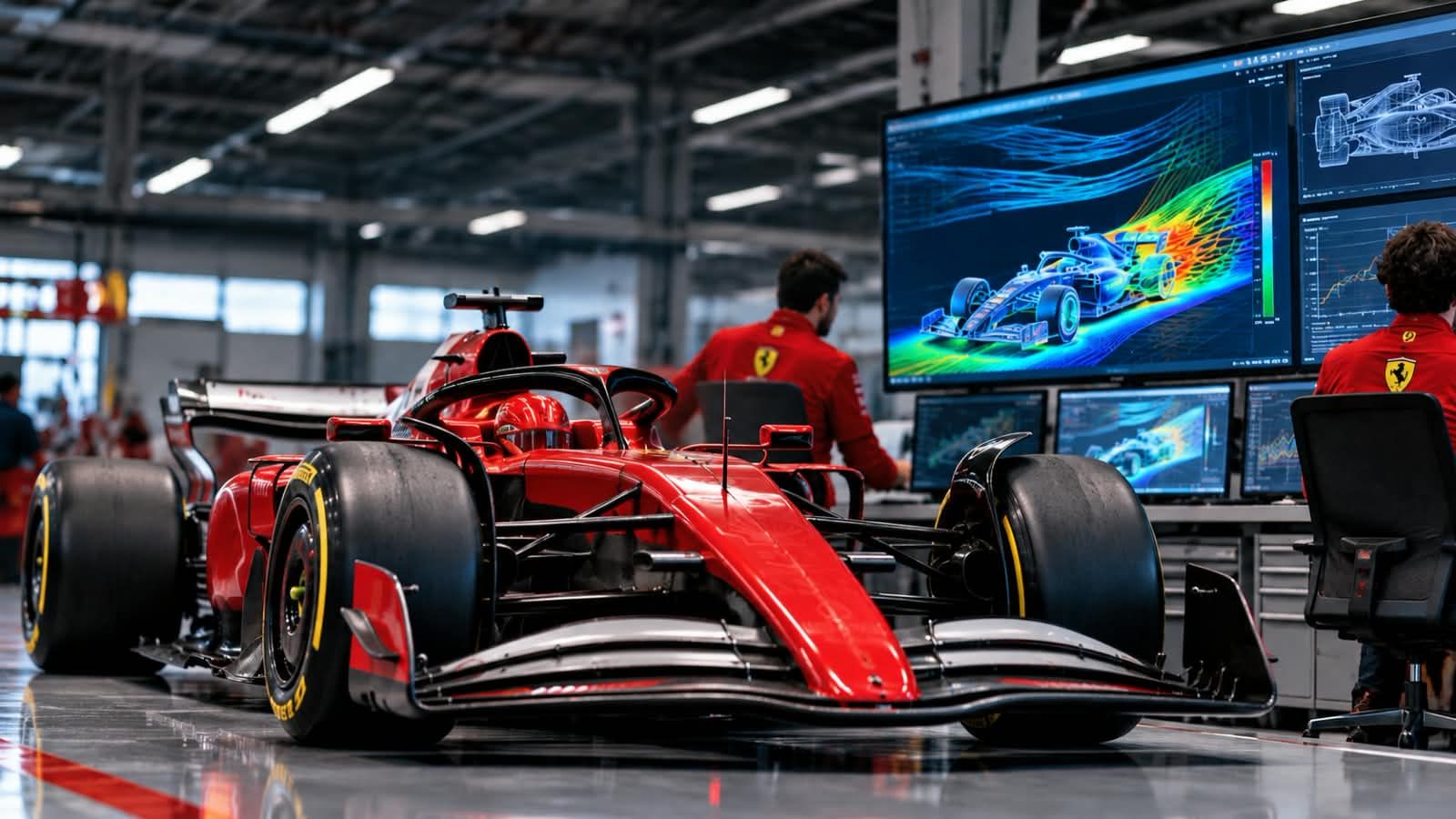
From CFD to AI-Assisted Design
Much of modern F1 car development happens before a new part ever reaches the track. Engineers use Computational Fluid Dynamics (CFD) to simulate how air moves around a virtual car. They can then change a wing, floor or diffuser and run another simulation.
The problem is that detailed simulations require significant computing resources. Machine learning can help by learning from existing simulation results and predicting which design directions are worth investigating. An AWS collaboration with Formula 1 previously demonstrated an approach where machine learning could help aerodynamicists select which concepts should receive further CFD testing. That does not eliminate CFD. Instead, AI can help engineers use their limited simulation time more intelligently.
AI Is Moving Beyond Aerodynamics
The bigger change is that AI is increasingly being applied across different parts of an F1 operation. McLaren's 2026 partnership with Intel, for example, includes computing support for workloads such as CFD, aerodynamic analysis, vehicle-dynamics simulation and race-strategy analytics.
This shows why AI in F1 is about more than simply generating a faster-looking shape. A modern F1 car is a connected system. Changing the aerodynamics can affect tyre behaviour, cooling, suspension requirements and energy management. Engineers therefore need to understand how different decisions interact. AI can potentially help connect those datasets and highlight relationships that would be difficult to find manually.
Alpine Takes a Bigger Step
One of the clearest recent examples came on October 1, when BWT Alpine Formula One Team announced a multi-year partnership with Apex Ultra. The partnership will bring Apex Ultra's Engineering Superintelligence technology into the design, simulation and development of Alpine's F1 cars. Alpine says the system is intended to reason across areas including aerodynamics, structures, thermodynamics, materials and manufacturing while working within F1's regulations.
The development is significant because it represents a move from using AI for individual tasks toward integrating engineering-focused AI more deeply into the development process. It is still early, however. Faster computer analysis does not automatically produce a faster racing car. Every promising idea must eventually survive simulation, manufacturing, testing and the realities of a race weekend.
Engineers Are Still in the Driver's Seat
The most important point is that AI is becoming an engineering assistant, not an autonomous F1 designer. Human engineers still decide what problems need solving, which compromises are acceptable and which designs should eventually be manufactured.
AI can search through possibilities much faster than a person can, but Formula 1 remains a physical sport. A computer-generated solution has to work with real tyres, real temperatures, real airflow and real regulations. That is where the real value of AI may emerge: not by replacing engineers, but by helping them learn faster.
What Comes Next
Formula 1's development race has always been about finding better ways to turn limited time and resources into performance. AI adds another layer to that competition.
As teams collect more simulation, manufacturing and track data, the ability to connect those datasets could become just as important as raw computing power. Reuters reported in May that AI was becoming increasingly integrated across F1, from engineering and race strategy to operations and rules analysis. The next generation of F1 cars may therefore be shaped by something fans rarely see: algorithms working quietly behind the scenes.
Career Takeaway
AI is creating new opportunities at the intersection of motorsport and engineering. Future F1 development teams are likely to need aerodynamicists, mechanical engineers and vehicle-dynamics specialists who can also understand data science, machine learning and simulation.
For students interested in motorsport, learning Python, data analysis, CFD and machine learning alongside a core engineering discipline could become a valuable combination
Useful Statistics
- Alpine announced a multi-year AI-for-engineering partnership with Apex Ultra.
- McLaren's Intel partnership covers CFD, aerodynamic analysis, vehicle-dynamics simulation and race-strategy analytics.
- An earlier Formula 1–AWS collaboration reported tripling CFD-run throughput while reducing turnaround time per run by half.
- Reuters reported that eight AI-related sponsorships had been signed in F1 over the preceding six months as of May 2026.